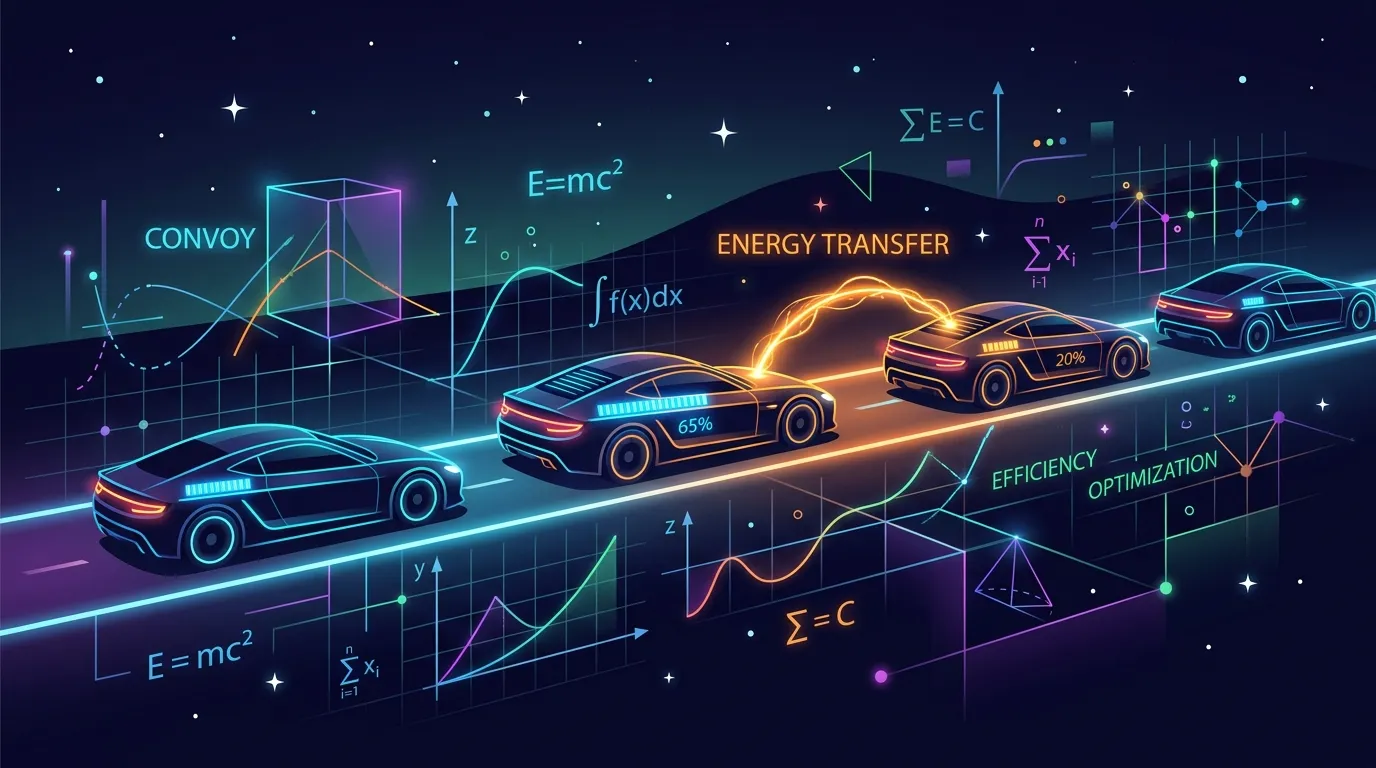
You have a package that must be deployed 150 km away. Your car has a full tank, but its range is only 100 km. With two such cars, each with a full tank, you can do it: drive both cars 50 km. Both tanks are now half empty. Transfer the remaining half-tank from one car to the other. The first car is now empty. The second car has a full tank, and it can go the additional 100 km to deploy the package.
But what if the destination is 250 km away? You can have as many cars as you want, all starting at the same line with full tanks, and you can freely transfer fuel between them. Can you make it? And if so, what is the fewest number of cars you need?
The original question by marcbreathes has been reworded slightly, but the meaning is the same.
The Setup
This puzzle runs in an ideal world with a few clear ground rules:
- Every car carries an identical fuel tank with a maximum range of 100 kilometers.
- All cars start at the same starting line with completely full tanks.
- Fuel transfers between tanks are instantaneous, frictionless, and lossless.
- Once a car runs dry, it is abandoned on the road.
- No fuel depots, shuttling, or backtracking are allowed — the convoy moves strictly forward.
We want to minimize the number of cars used, which also means minimizing the total fuel consumed. Only one car ever reaches the destination — having more cars arrive is a waste of resources. The rest are used to ferry fuel and are abandoned along the way. The remaining cars are not wasted though: they serve as fuel couriers for the one car that makes it.
A car should not drive any farther than it has to. Every kilometer a donor car travels is a kilometer of fuel burned for no forward progress. So each donor car should transfer its remaining fuel to the others as soon as the transfer is physically possible.
Our goal: find the fewest cars needed to cross 250 kilometers.
The 150-Kilometer Warmup
Let’s start simple. We have two cars and a destination 150 km away.
Both cars drive together. After 50 km, each car has burned exactly half its fuel. Each has 50 km of range left, and each has 50 km of empty space in its tank.
Now the handoff: Car 1 transfers its remaining fuel into Car 2. Car 1 is now empty and abandoned. Car 2 has a completely full tank at the 50 km marker and drives its full 100 km range from there:
Mission accomplished.
Why Exactly 50 Kilometers?
What happens if the drivers stop at 40 km instead?
At 40 km, both cars have 60 km of fuel remaining. But Car 2 only has 40 km of empty tank space — it cannot accept all of Car 1’s fuel. Twenty km of fuel is left stranded in the abandoned car. That is wasted range.
What about stopping at 60 km? Both cars still have 40 km of fuel each, and Car 2 has room for all of it. But two engines drove an extra 10 km for no reason. You burned extra fuel to move two cars when you only needed to move one.
Fifty kilometers is the minimum distance we must drive before the transfer is possible. Go shorter and fuel is stranded in the abandoned car. Go longer and two engines burned fuel for no reason.
Adding a Third Car
What if we bring three cars?
We want the same trick: shed one empty car as early as possible and leave the survivors with completely full tanks. To keep the arithmetic clean, imagine each tank holds exactly 3 cups of fuel. Three cups take a car 100 km. Across three cars that’s 9 cups total.
We drive all three forward together. How far until one car can transfer all its fuel to the other two?
- After all 3 cars have traveled one-third of the way (100/3 km = 33.33 km), each has used up 1 cup. Each car has 2 cups left.
- The two surviving cars each have space for 1 cup — 2 cups in total. The amounts match, just like in the 2-car case.
- The donor car empties 1 cup to each of the other cars and is abandoned. The other two cars each have a full tank.
So each car drives until it has burned 1 cup. Since 3 cups = 100 km, burning 1 cup covers:
Cars 1 and 2 now have full tanks — and this is exactly the start of the 2-car case. They can drive the 2-car distance of 150 km from here. So:
Adding a 3rd car added 33.33 km to our range.
The Emerging Pattern
Do you see it?
- 1 car: range =
- 2 cars: add
- 3 cars: add
Each extra car gets you another slice of distance, although each slice is smaller.
With 4 cars we add another , after which one car is abandoned and we move on to the 3-car case:
Still short of 250 km. Let’s tabulate:
| Fleet size | Extra distance added | Cumulative range | Reaches 250 km? |
|---|---|---|---|
| 1 | — | 100 km | No |
| 2 | km | 150 km | No |
| 3 | km | 183.33 km | No |
| 4 | km | 208.33 km | No |
| 5 | km | 228.33 km | No |
| 6 | km | 245 km | No |
| 7 | km | 259.29 km | Yes (9.29 km to spare) |
cars are enough.
That’s it! Seven cars. That’s the answer.
But if you want to proceed further… Things will get a bit complicated now.
The General Formula
As we’ve seen from the table, each group of cars adds km to our range. Let be the maximum range achievable with cars. With cars, we add km, abandon one car, and are left with cars — so
Taking 100 as a common factor:
Mathematicians have studied that sum for centuries. It is called the Harmonic Number, . You start at 1 and keep adding the next smaller unit fraction until you reach your target. For example, the 4th harmonic number is:
In general:
Exactly what we have. So our maximum convoy range is:
To drive distance , find the smallest such that . The harmonic series is infinite, so we can reach any distance in theory — but we need a lot of cars.
Is This Strategy Truly Optimal?
Could a clever driver do better — trickling fuel continuously, or using uneven drops?
Let’s verify by working backwards from a different angle: the rate at which the fleet burns fuel.
One full tank moves one car 100 km, so with cars we have tanks of fuel. How fast does the fleet burn fuel?
- 1 car driving: burns 1 tank per 100 km
- 2 cars driving: burn 2 tanks per 100 km
- cars driving: burn tanks per 100 km
Every running car uses fuel. We want as few cars running as possible.
Can we put all the fuel into one car and run a single engine the whole way? No — a car holds exactly one tank of fuel.
So how many cars do we need on the road at any moment? It depends on how much fuel the fleet has left:
- Between 4 and 5 full tanks remaining: that fuel cannot fit into 4 cars — we need at least 5.
- Between 2 and 3 tanks left: we need at least 3 cars.
- In general: if the fleet holds anywhere between and full tanks, we need at least cars on the road.
Now divide the journey into slices by 1 tank of fuel consumed:
- The fleet starts with full tanks. While the -th tank burns down (), we need exactly cars. Those cars will use up 1 tank of fuel and cover km together.
- The moment total fuel drops to tanks, we must immediately consolidate — one car is abandoned and the remaining cars burn the next tank together, covering km.
- We continue in the same way. From 3 to 2 tanks, with 3 cars running, the convoy covers km.
- From 2 to 1 tank, with 2 cars, it covers km.
- The final car drives the last tank alone for km.
The same result as before.
This bound is tight for two reasons:
- Every extra car is dead weight: if you run more cars than the minimum needed to hold your remaining fuel — say, 4 cars when 3 could already hold it all — your fleet burns fuel faster than it has to.
- Every abandoned drop is wasted range: if you abandon a car that still has fuel in it, that fuel is never converted into forward motion.
Our strategy avoids both. Surviving cars hold 100% of fuel and abandoned cars hold 0% at the moment of abandonment — we use every single drop. The harmonic formula is the best anyone can do.
The Tyranny of Logarithmic Growth
Back in the fourteenth century, Nicole Oresme proved that the harmonic series diverges to infinity1. Keep adding and the sum eventually exceeds any number you choose. So, in theory, our convoy can reach the Moon, Pluto, or the edge of the observable universe. There is no distance cap.
The harmonic numbers grow logarithmically:
where is the Euler—Mascheroni constant. Because , the required fleet size explodes exponentially with target distance:
While we can go any distance, we’ll need a lot of cars. Every extra stretch of road requires exponentially more donor cars.
| Distance | Cars needed |
|---|---|
| 100 km (Single tank limit) | 1 |
| 150 km (Two-car range) | 2 |
| 200 km | 4 |
| 250 km (Mission target) | 7 (Our answer) |
| 500 km | 83 |
| 1,000 km | 12,367 |
| 10,000 km | (Nears all water molecules in Earth’s oceans) |
| 20,037.5 km (Halfway around the Earth) | (Far exceeds all atoms in the observable universe2) |
| 30,000 km (Longest motorable road) | (Surpasses all possible chess games) |
| 40,075 km (Full Earth circumference) | (Exceeds all board positions in Go) |
We do not have enough matter in the observable universe to build the cars needed to push a payload halfway around the globe.
Sanity Checks
Every good model deserves stress testing.
- Limiting case : . A solo car drives its tank exactly dry. Correct.
- Limiting case : , but the marginal gain . Range grows without bound, but each extra car yields vanishingly small returns.
- Monotonicity: Adding a car always strictly increases range (). But the marginal gain strictly decreases (). The range curve is monotonically increasing and strictly concave — diminishing marginal returns.
In the Real World
Of course, this is impossible in the real world. You are hauling dead weight — 1,500 kilograms of metal per car along with the fuel. An 83-car convoy will cause massive drag and gridlock, while cars would gravitationally collapse into a black hole. Not to mention, six drained cars stranded on a highway will cause a logistical nightmare.
However, real rockets do use staging. Instead of hauling empty metal tanks all the way to orbit, they jettison depleted stages mid-flight. Shedding this dead weight continuously is the only practical way to reach escape velocity without requiring an impossibly massive fuel load at launch.